Wednesday, February 4, 2009

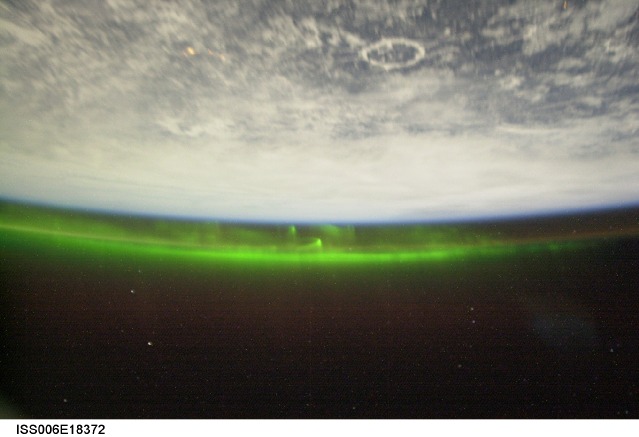
Aurora from space...

Credit: Don Pettit, ISS Expedition 6, NASA
Explanation: From the ground, spectacular auroras seem to dance high above. But the International Space Station (ISS) orbits at nearly the same height as many auroras, sometimes passing over them, and sometimes right through them. Still, the auroral electron and proton streams pose no direct danger to the ISS. In 2003, ISS Science Officer Don Pettit captured the green aurora, pictured above in a digitally sharpened image. From orbit, Pettit reported that changing auroras appeared to crawl around like giant green amoebas. Over 300 kilometers below, the Manicouagan Impact Crater can be seen in northern Canada, planet Earth.

Sunday, February 1, 2009

Milky Way

The Milky Way Over Mauna Kea
Credit & Copyright: Wally Pacholka (TWAN)
Explanation: Have you ever seen the band of our Milky Way Galaxy? In a clear sky from a dark location at the right time, a faint band of light becomes visible across the sky. Soon after your eyes become dark adapted, you might spot the band for the first time. It may then become obvious. Then spectacular. One reason for a growing astonishment might be the realization that this fuzzy swath contains billions of stars and is the disk of our very own spiral galaxy. Since we are inside this disk, the band appears to encircle the Earth. Visible in the above image, high above in the night sky, the band of the Milky Way Galaxy arcs. The bright spot just below the band is the planet Jupiter. In the foreground lies the moonlit caldera of the volcano Haleakala, located on the island of Maui in Hawaii, USA. A close look near the horizon will reveal light clouds and the dark but enormous Mauna Kea volcano on the Big Island of Hawaii. If you have never seen the Milky Way band or recognized the planet Jupiter, this year may be your chance. Because 2009 is the International Year of Astronomy, an opportunity to look through a window that peers deep into the universe may be coming to a location near you.

Sunday, January 11, 2009

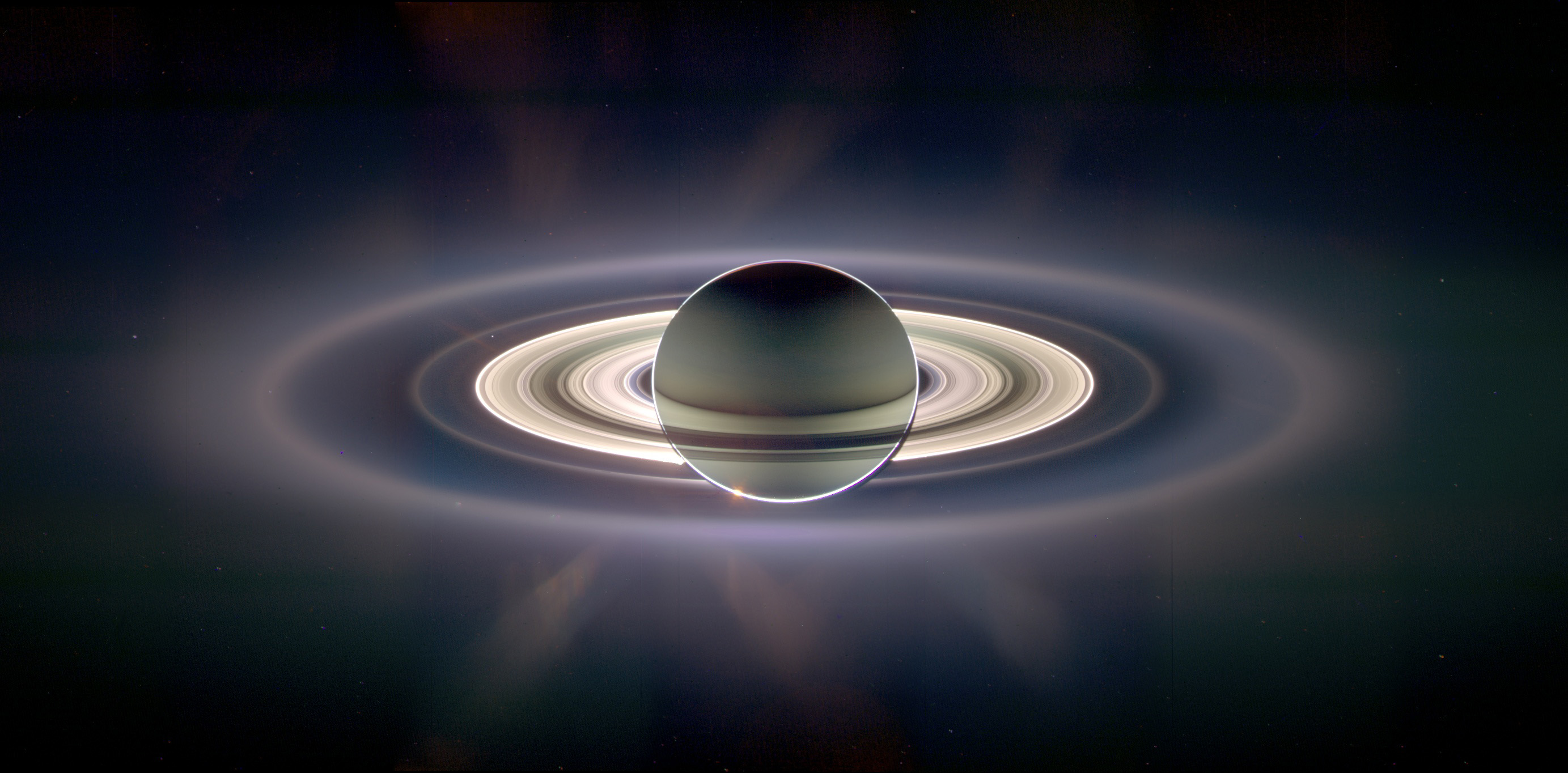
Saturn

Credit: Cassini Imaging Team, SSI, JPL, ESA, NASA
Explanation: In the shadow of Saturn, unexpected wonders appear. The robotic Cassini spacecraft now orbiting Saturn recently drifted in giant planet's shadow for about 12 hours and looked back toward the eclipsed Sun. Cassini saw a view unlike any other. First, the night side of Saturn is seen to be partly lit by light reflected from its own majestic ring system. Next, the rings themselves appear dark when silhouetted against Saturn, but quite bright when viewed away from Saturn and slightly scattering sunlight, in the above exaggerated color image. Saturn's rings light up so much that new rings were discovered, although they are hard to see in the above image. Visible in spectacular detail, however, is Saturn's E ring, the ring created by the newly discovered ice-fountains of the moon Enceladus, and the outermost ring visible above. Far in the distance, visible on the image left just above the bright main rings, is the almost ignorable pale blue dot of Earth.

Martian Sunset


Credit: Mars Exploration Rover Mission, Texas A&M, Cornell, JPL, NASA
Explanation: This month, the Mars Exploration Rovers are celebrating their 5th anniversary of operations on the surface of the Red Planet. The serene sunset view, part of their extensive legacy of images from the martian surface, was recorded by the Spirit rover on May 19, 2005. Colors in the image have been slightly exaggerated but would likely be apparent to a human explorer's eye. Of course, fine martian dust particles suspended in the thin atmosphere lend the sky a reddish color, but the dust also scatters blue light in the forward direction, creating a bluish sky glow near the setting Sun. The Sun is setting behind the Gusev crater rim wall some 80 kilometers (50 miles) in the distance. Because Mars is farther away, the Sun is less bright and only about two thirds the size seen from planet Earth.

Wednesday, December 31, 2008

Happy New Year!

Rylands Transcript

The oldest known New Testament fragment is the Rylands Transcript, found in Egypt, now in Manchester England. It contains John 18: 31 - 33 and 37-38 (NKJV):

"31 Then Pilate said to them, “You take Him and judge Him according to your law.” Therefore the Jews said to him, “It is not lawful for us to put anyone to death,” 32 that the saying of Jesus might be fulfilled which He spoke, signifying by what death He would die. 33 Then Pilate entered the Praetorium again, called Jesus, and said to Him, “Are You the King of the Jews?”
.....
(34 Jesus answered him, “Are you speaking for yourself about this, or did others tell you this concerning Me?” 35 Pilate answered, “Am I a Jew? Your own nation and the chief priests have delivered You to me. What have You done?” 36 Jesus answered, “My kingdom is not of this world. If My kingdom were of this world, My servants would fight, so that I should not be delivered to the Jews; but now My kingdom is not from here.”)
.........
"37 Pilate therefore said to Him, “Are You a king then?” Jesus answered, “You say rightly that I am a king. For this cause I was born, and for this cause I have come into the world, that I should bear witness to the truth. Everyone who is of the truth hears My voice.” 38 Pilate said to Him, “What is truth?” And when he had said this, he went out again to the Jews, and said to them, “I find no fault in Him at all."

Wednesday, December 24, 2008


Micah 5:2
"But you, Bethlehem Ephrathah, though you are small among the clans of Judah, out of you will come for me one who will be ruler over Israel, whose origins are from of old, from ancient times. "