Friday, June 1, 2007

Messier 65


Credit & Copyright: Volker Wendel
Explanation: M65 is a big, beautiful spiral galaxy, the sixty-fifth object in the famous astronomical catalog compiled by 18th century cosmic tourist Charles Messier. It's also a member of a picturesque trio of large spiral galaxies known as the Leo Triplet, about 35 million light-years away. This sharp view of M65 shows off the galaxy in remarkable detail, with tightly wound spiral arms and dust lanes stretching into a core dominated by the yellowish light from an older population of stars. In fact, M65 seems to be the least disturbed of the Leo Trio, though it is close enough to be interacting gravitationally with the other two galaxies (not seen here). Very nearly edge-on to our line-of-sight, M65 is about 100,000 light-years across, similar in size to our Milky Way Galaxy.

Wednesday, May 30, 2007

Look What The Cat Dragged In!


HA HA HA HA!!! I got this in an email this AM and just had to share!

"One week after being born, six baby skunks were abandoned by their mother. Luckily, we had just weaned five kittens off of our resident farm cat a day before and hoped that perhaps she might take them on as her own. She was reluctant at first, but she let them nurse – a positive sign. Two weeks have gone by and the six little "Stinkers" are thriving and their new mom couldn't be happier. She has become quite devoted to them and even carries them around to show them off to visitors."

Monday, May 28, 2007

Thank You To All Our Troops!


Hat tip My Republican Blog for the cool picture!

It's a good time to send the troops a card: http://www.letssaythanks.com/Home1280.html

Sunday, May 27, 2007

Infiltration ~ Paul Sperry


This is another book I've had in the "to read" pile, which I finally got to. It covers in great detail all the little loopholes through which jihadists have infiltrated our free society, and it's pretty scary. For example, foreign nationals from terrorist sponsoring states frequently tour our nuclear laboratories and power plants to 'learn about' our security measures. Can you imagine? Crazy. Almost nobody in government has even bothered to read the koran! Incredible. No wonder they're so clueless. Anyhow, here's the Sperry suggestions to combat islamic terrorism:

1. Citizens should examine and protest building of mosques in their backyard.
2. Enforce the oath of allegiance (no dual citizenship with terror nations).
3. Profile muslim travelers.
4. Audit muslim charities and mosques.
5. Break all government ties with CAIR.
6. Expose the Saudi embassy (due to its connection and prior knowledge of 911).
7. Deny secuity clearance to muslim activists.
8. Offer scholarships in arabic language studies.
9. Fight muslim activism in public schools.
10. Step up counterterrorism training at Quantico.

and... here's his website: http://www.sperryfiles.com/

Saturday, May 26, 2007

Giant Alabama Pig


In this photo released by Melynne Stone, Jamison Stone, 11, poses with a wild pig he killed near Delta, Ala., May 3, 2007. Stone’s father says the hog weighed a staggering 1,051 pounds and measured 9-feet-4 from the tip of its snout to the base of its tail. If claims of the animal’s size are true, it would be larger than “Hogzilla,” the huge hog killed in Georgia in 2004. (AP Photo/Melynne Stone).

Hat tip LGF

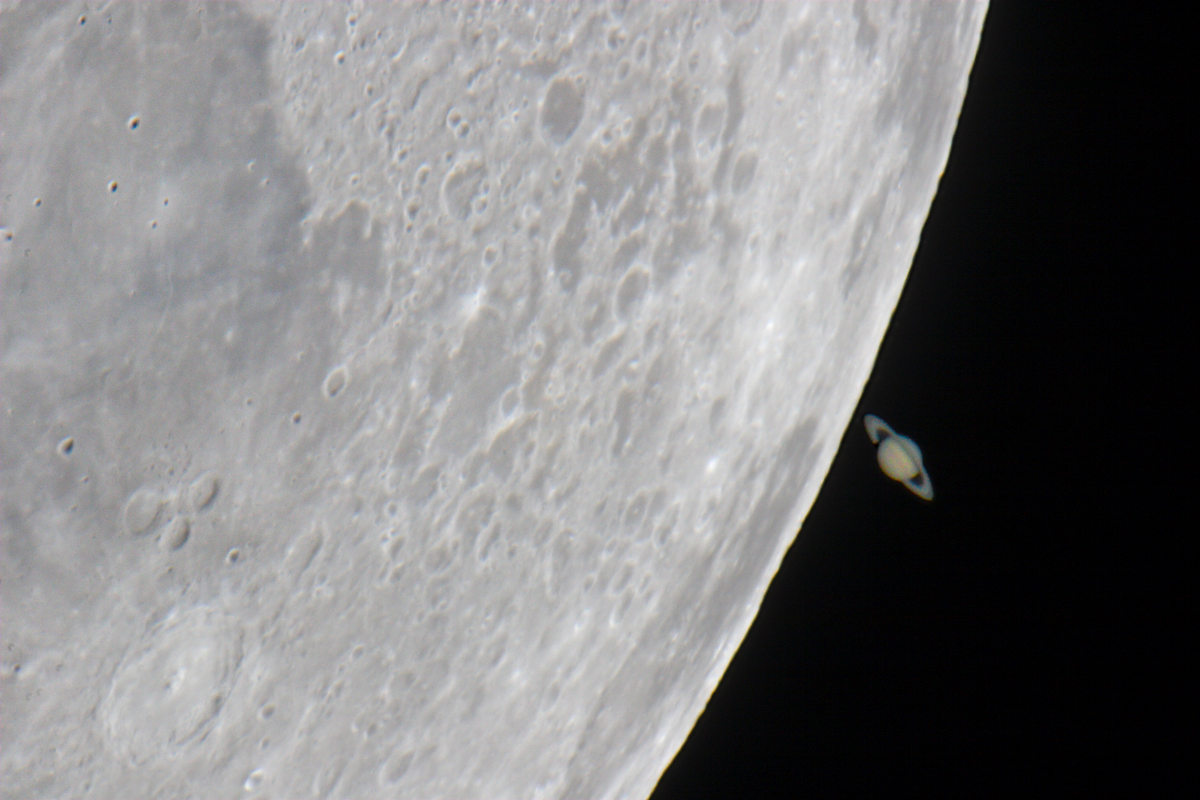
The Moon's Saturn


Credit & Copyright: Jens Hackmann
Explanation: On May 22nd, just days after sharing the western evening sky with Venus, the Moon moved on to Saturn - actually passing in front of the ringed planet when viewed in skies over Europe, northern Africa, and western Asia. Because the Moon and bright planets wander through the sky near the ecliptic plane, such occultation events are not uncommon, but they are dramatic, especially in telescopic views. For example, in this sharp image Saturn is captured emerging from behind the Moon, giving the illusion that it lies just beyond the Moon's bright edge. Of course, the Moon is a mere 400 thousand kilometers away, compared to Saturn's distance of 1.4 billion kilometers. Taken with a digital camera and 20 inch diameter telescope at the Weikersheim Observatory in southern Germany, the picture is a single exposure adjusted to reduce the difference in brightness between Saturn and the cratered lunar surface.

Friday, May 25, 2007